Search
Disclaimer

Clicking the images or links will redirect you to a website hosted by BenchSci that provides third-party scientific content. Neither the content nor the BenchSci technology and processes for selection have been evaluated by us; we are providing them as-is and without warranty of any kind, including for use or application of the Thermo Fisher Scientific products presented.
Invitrogen
CaV1.1 Monoclonal Antibody (1A)
Promotions
View available promotion(s)
Promo Code: RGLOW25 Save up to $900 and get the limited-edition holiday sweatshirt + matching beanie It’s been a year – this is your badge of honor for fluorescing through it all. Offer available until December 27.. Learn more
Spend Now, Save Big Later! Spend Now, Save Big Later! Make your New year's resolution to save: earn up to $3,500 off a future January offer when you purchase a qualifying amount before December 31st. Learn more
Application
FIGURE: 1 / 32
CaV1.1 Antibody (MA3-920) in IHC (P)
Immunohistochemistry was performed on normal biopsies of deparaffinized human skeletal muscle tissue. To expose target proteins, heat induced antigen retrieval was performed using 10mM sodium citrate (pH6.0) buffer, microwaved for 8-15 minutes. Following antigen retrieval tissues were blocked in 3% BSA-PBS for 30 minutes at room temperature. Tissues were then probed at a dilution of 1:20 with a Mouse Monocl... View More


.jpg?time=20240507)


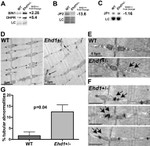


.jpg?time=20240507?time=20240507 "CaV1.1 Antibody (MA3-920) in IHC")




Product Details
MA3-920
Applications
Tested Dilution
Publications
Product Specifications
Species Reactivity
Guinea pig,
Human,
Mouse,
Rabbit,
Rat
Published species
C. elegans,
Fish,
Human,
Mouse,
Non-human primate,
Rabbit,
Rat,
Zebrafish
Host/Isotype
Mouse
/ IgG1
Class
Monoclonal
Type
Antibody
Clone
1A
Immunogen
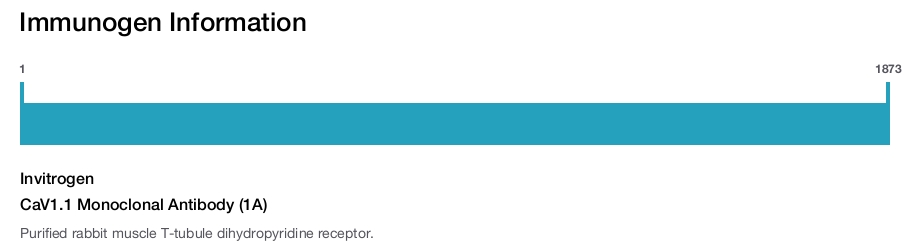
Purified rabbit muscle T-tubule dihydropyridine receptor.
Conjugate
Unconjugated
Form
Liquid
Concentration
1 mg/mL
Purification
Protein A
Storage buffer
PBS, pH 7.4
Contains
0.05% sodium azide
Storage conditions
-20°C, Avoid Freeze/Thaw Cycles
Shipping conditions
Ambient (domestic); Wet ice (international)
RRID
Product Specific Information
MA3-920 detects 1,4-dihydropyridine (DHP) receptor alpha-1 subunit in human, rat, mouse, guinea pig and rabbit skeletal muscle. The DHP Receptor alpha-1 protein is also known as CACNA1S or Cav1.1 alpha-1 subunit.
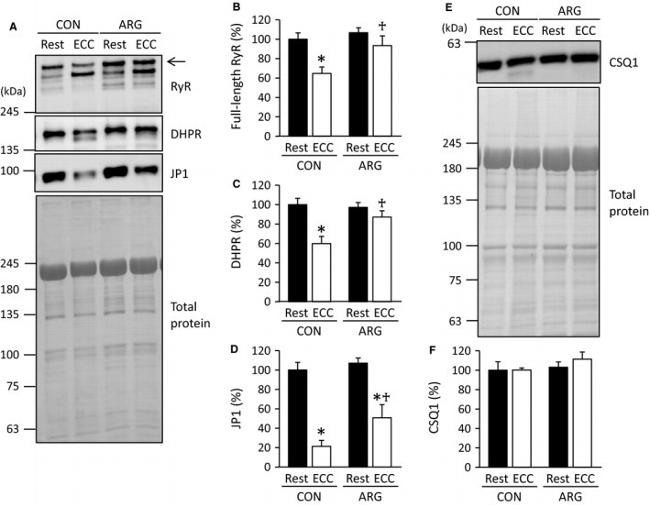
MA3-920 has been successfully used in Western blot, FACS, immunohistochemistry and immunoprecipitation procedures. By Western blot, this antibody detects an ~200 kDa protein representing the DHP receptor in rat skeletal muscle extracts. Immunohistochemical staining of DHP receptor in rabbit skeletal muscle with MA3-920 results in double rows of discrete punctate staining representing pairs of triads on the opposing sides of the Z-lines. This product can be used to inhibit the DHP-sensitive calcium current in BC3H1 mouse muscle cells.
The MA3-920 antigen is purified rabbit muscle T-tubule DHP receptor.
Target Information
Voltage-sensitive calcium channels mediate the entry of calcium into many types of excitable cells and thus play a key role in neurotransmitter release and excitation-contraction (E-C) coupling. The 1,4-dihydropyridines (DHPs) are synthetic organic compounds which can be used to identify the L-type calcium channels that are found in all types of vertebrate muscle, neuronal and neuroendocrine cells. The DHP receptor is part of the L-type calcium channel complex and is thought to be the voltage sensor in E-C coupling. The purified DHP receptor isolated from triads is composed of at least four subunits. The alpha-1 subunit contains the binding site for the DHPs and shows high sequence homology to the voltage gated sodium channel. The alpha-2 subunit is a large glycoprotein associated with the DHP receptor which was first described in skeletal muscle and is also found in high concentrations in other excitable tissues such as cardiac muscle and brain and in low concentrations in most other tissues studied. The other two subunits that co-purify with the DHP receptor are termed beta and gamma.
For Research Use Only. Not for use in diagnostic procedures. Not for resale without express authorization.
Related Products for
Western Blot


Bioinformatics
Protein Aliases: calcium channel, L type, alpha 1 polypeptide, isoform 3 (skeletal muscle, hypokalemic periodic paralysis); Calcium channel, L type, alpha-1 polypeptide, isoform 3, skeletal muscle; calcium channel, voltage-dependent, L type, alpha 1S subunit; Cav1.1 alpha-1; DHP; DHPR; DHPR alpha1s; dihydropyridine calcium channel receptor protein; Dihydropyridine receptor; dihydropyridine receptor alpha 1 subunit; dihydropyridine receptor alpha 1S; Dihydropyridine receptor alpha-1S subunit; dihydropyridine-sensitive L-type calcium channel alpha-1 subunit; muscle dysgenesis; ROB1; unnamed protein product; Voltage-dependent L-type calcium channel subunit alpha-1S; Voltage-gated calcium channel subunit alpha Cav1.1
Gene Aliases: AW493108; CACH1; Cach1b; CACN1; CACNA1S; CACNL1A3; Cav1.1; CCHL1A3; DHPR; fmd; HOKPP; HOKPP1; hypoPP; mdg; MHS5; sj; TTPP1
UniProt ID: (Human) Q13698, (Rabbit) P07293, (Rat) Q02485, (Mouse) Q02789
Entrez Gene ID: (Human) 779, (Rabbit) 100009585, (Rat) 682930, (Mouse) 12292, (Guinea pig) 100734741

Performance Guarantee
If an Invitrogen™ antibody doesn't perform as described on our website or datasheet,we'll replace the product at no cost to you, or provide you with a credit for a future purchase.*
Learn more
We're here to help
Get expert recommendations for common problems or connect directly with an on staff expert for technical assistance related to applications, equipment and general product use.
Contact tech support